Package the software and its models
Test the application, model versions and dependencies against the target hardware. A model change becomes part of a tested application release.
SIGMA brings deployment, configuration and software updates under central management. Deliver tested applications and their AI models to remote sites, then improve them as requirements change.
Manage applications and their packaged AI models across remote sites.
Each reel opens with SIGMA management. Diagrams illustrate the workflow; five seconds of recorded lab footage show one deployed application. Muted playback with on-screen explanations.
Test the application, model versions and dependencies against the target hardware. A model change becomes part of a tested application release.
Use SIGMA to deploy and configure the workload on compatible edge compute. This demonstrator keeps vision processing and datalogging in separate applications.
Manage software updates centrally. Add compatible models, detection tasks and features over time, reducing routine site visits for software changes.
Model development and validation remain engineering tasks. SIGMA manages deployment and lifecycle of the applications that contain those models.
SIGMA architecture and application management ↗For frontier AI companies such as xAI, deploying proprietary models at remote sites creates a need for device trust, protection of model files and remote control of deployments. This is an illustrative use case, not a claim of an xAI deployment or partnership.
Hardware-backed measured boot and remote attestation provide evidence of device integrity, subject to supported hardware and the configured policy.
Use encrypted storage and controlled application access for proprietary model files. Storage encryption and boot attestation do not by themselves guarantee confidentiality of model weights during execution.
Remotely deactivate or remove the application that carries the model. The device must receive the change; this is not immediate revocation on an offline device or a recall of weights already copied elsewhere.
The slide describes a deployment design using platform capabilities. Attestation enforcement and proprietary-model protection have not been validated on this demonstration’s Jetson.
Attestation architecture ↗ · Platform security ↗ · Application deactivation and removal ↗
Actual application outputs captured on 24 September 2026. These examples come from different points in the feed history.
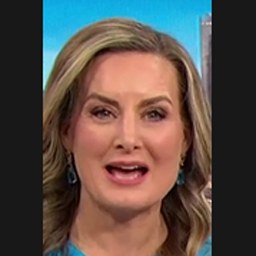 26m 08s visible · 124 returns
ABC NEWS, recorded 24-hour window. Repeat appearances accumulate against a visual face cluster; this does not establish a person's identity.
As Xi Jinping's three-day visit to Washington begins, I'm going to ask you to take a look at the
BBC News · 2026-09-24T00:02:24.163509+00:00. Timestamped speech samples from CUDA Whisper on the Jetson; sampled coverage can leave gaps.
Trump and Xi to discuss AI, trade, Taiwan
Raw headline excerpt from BBC News. Weather graphics also become structured records: Hobart — Today 21°C; Tue 20°C. These are recorded extraction results, not a current forecast.
The programme reported on Chinese President Xi Jinping's three-day visit to Washington, with trade, Iran and AI described as agenda items.
Evidence: transcript 11, 13, 14 and on-screen text 3.Feed-derived speech and OCR become a summary, events and evidence references. Optional article matching is separate; missing or uncertain passages remain flagged.
After a fragmentary headline sequence, presenter Katrina Perry introduced Chinese President Xi Jinping's three-day US visit. The report and an unidentified expert discussed the strained US-China relationship, Taiwan, arms, tariffs, rare-earth supplies and competition over AI; much of the exchange was incomplete. The programme then moved to the UN General Assembly. Venezuela's interim president Delcy Rodríguez called for dialogue and diplomacy and thanked the Trump administration for a stated readiness to resume unspecified engagement. The bulletin referenced Ukraine-Russia diplomacy, remarks by Volodymyr Zelensky and Iran's response to possible US sanctions. UN human-rights chief Volker Türk then described civilian harm and wider repercussions from conflict, called for accountability under international law, and criticised restrictions by Iranian authorities on peaceful assembly and gender equality. His final comments turned to the continuing war in Ukraine but ended mid-sentence.
[00:00:03–00:01:14] Headlines/ticker: Andy Burnham; Olivia Rodrigo; Harvey Weinstein sentenced to 15 years in prison for sexual assault. [The same text repeats.] [unclear]

[00:01:24] She hopes to build bridges around the world, and a judge weighs up [unclear]. The White House says the move is on national-security grounds.

[00:01:44] Presenter: Hello, I'm Katrina Perry.

[00:01:58] Chinese President Xi Jinping [arrives in] Washington, DC, for a three-day state visit to the US. He was met [unclear]. [It was the first such welcome for a foreign leader] at the air base since 1962. [Trade], Iran and AI [are] top of the agenda. President Xi will be honoured with [unclear].

[00:02:24] Presenter/Reporter: As Xi Jinping's three-day visit to Washington begins, I'm going to ask you to take a look at the [relationship] between the US and China and how it differs now from that of past [administrations]. Marco Rubio is a well-known China hawk, and there are others in President Trump's [administration who believe China] is the greatest strategic threat on the global stage to America. [unclear]

[00:03:35] Presenter/Reporter: This issue of Taiwan: we know President Xi has readied his troops to [unclear]. There is a multibillion-dollar package of weapons which the United States is [providing]. [unclear] President Xi, the last time they met, [unclear], and he sees that as a bargaining chip—to [sell weapons] to Taiwan or agree to delay it for months or years in his talks. So that's something he wants to deliver. [The] US president [unclear] is very unlikely [to say whether] he would send troops or forces to defend Taiwan. [Taiwan is also important] for the crucial manufacture of computer chips there, something Donald Trump, like the rest of the world, [unclear].

[00:04:33] Presenter: [A guest from Georgetown] University Center for Security and Emerging Technology. And I asked him [unclear].

[00:04:43] Guest: The number of things—first and foremost, is this visit going to be about substance, or is it going to be about [pageantry]? [It will be] mostly about pageantry and a little bit of a pro forma visit to try to keep things [unclear]. [This] has been coming for the last six months or so, and [they] want to get that [unclear]. Tariffs [unclear].

[00:05:25] Presenter/Guest: [It is] less clear at this point. And just on that point about the export controls on [unclear], [could this lead] to the trade war that we saw just a few months ago, with those astronomical tariffs? [There is expected] to be some kind of extension. The United States government is a little bit upset. [The supplies that China] said would be flowing to US companies [have not all] actually gotten to US companies over this past period. [There is an issue involving] rare-earth materials. It's unclear whether or not the pause is going to be [extended, or whether this is the Chinese] government acting to forestall the regular flows of rare earths, or [unclear].

[00:06:34] Presenter: [Are there] grounds for any sort of framework agreement? Do you see anything emerging from this trend?

[00:06:44] Guest: [The agreement] announced—or [unclear] announced—on Sunday is a good starting point. There's [unclear] incidents, and then there's a longer-form, longer-term dialogue. [unclear] China [unclear]. The United States has gone out of its way to forestall [China's] own AI development. [A] national notification mechanism [may] be about as much as we can hope for. [unclear] America [and China] are not quite aligned. I wonder if, in six to twelve months, [unclear] the emerging capabilities that a lot of US labs are talking about, but at this point I can't see [unclear]. [AI is] part of its development, its national security, its economy, and so [unclear].

[00:08:33] Presenter: In New York, world leaders continue to address the UN General Assembly, [following an address by] US President Donald Trump yesterday.

[00:09:04] Presenter: [Venezuela's interim president, Delcy Rodríguez,] said in her address that she hoped to build a new bridge.

Delcy Rodríguez: [Relations must be] rooted in dialogue, negotiations and diplomacy. We wish to [unclear]. [Relations with] the international community—we wish to rebuild them and maintain them. They must be rooted in [unclear]. [We use the] United Nations to thank President Donald Trump and his government for their readiness to resume [unclear]. The last time that two presidents, the president of Venezuela and the United States, [unclear]. [We are] working solemnly to, through dialogue, settle our differences, [unclear] energy, to promote security and to fight together [unclear] and economic [unclear].

[00:10:24] Presenter: [There were discussions about the] peace process between Ukraine and Russia on the sidelines of the summit. More than 50 countries [unclear]. Ukrainian President Volodymyr Zelensky took to the podium, calling the war “ridiculous” [unclear].

[00:10:54] Presenter: [unclear] The Iranian president has responded [to the prospect of] US sanctions. He said Tehran was ready for dialogue but wouldn't accept [unclear]. The Iranian president referenced a deadly attack on a primary school in Minab [unclear].

[00:11:36] Presenter: These meetings at the UN in New York [unclear]. Volker Türk, the United Nations High Commissioner for Human Rights, [was asked about] the biggest concerns relating to the Iran war.

Volker Türk: [The impact of] hostilities [and attacks on] civilians is a huge concern, but at the same time [unclear]. We don't really know what is going on and what the future is, so yes, we need urgent [unclear]. It has reverberations everywhere, and it affects in particular [unclear].

[00:12:54] Presenter: Can I ask you a bit about the criticism we heard from President Trump during his address to the [UN, and findings] from the UN Fact-Finding Mission that said there were reasonable grounds to think [unclear]?

Volker Türk: [There can be] no equivalence between what might have been accidental deaths [and unclear]. International law treats everyone [unclear]. There needs to be accountability for it. I myself was very clear about [unclear] earlier this year. There needs to be accountability; there needs to be an [unclear]. That's one thing. At the same time, it is totally unacceptable that the Iranian authorities [prevent people from exercising] fundamental human rights such as peaceful assembly [and] gender equality [unclear].

[00:14:14] Presenter: We know that the war in Ukraine is continuing. President Zelensky [unclear].

Volker Türk: [unclear] escalation of the warfare in Ukraine [unclear]. It will never bend the knee [unclear]. It's actually abuse in the most gruesome manner by the Russian [unclear].
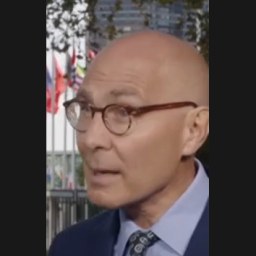 Face cluster 000918
2m 10s visible in this BBC News block.
First seen 00:12:01; last seen 00:15:11 UTC.
The enriched story describes discussion of civilian harm and accountability. The face record belongs to the same broadcast block.
“Volker Turk · United Nations High Commissioner for Human Rights”
OCR evidence: chyron:21, 00:13:21 UTC — within this face record's observation window. The story participant record references that same caption.
This connects the face record, on-screen mention and story for review. It does not confirm that the face is the named person; a first-to-last window can include gaps.
Inspect the face-to-story evidence ↗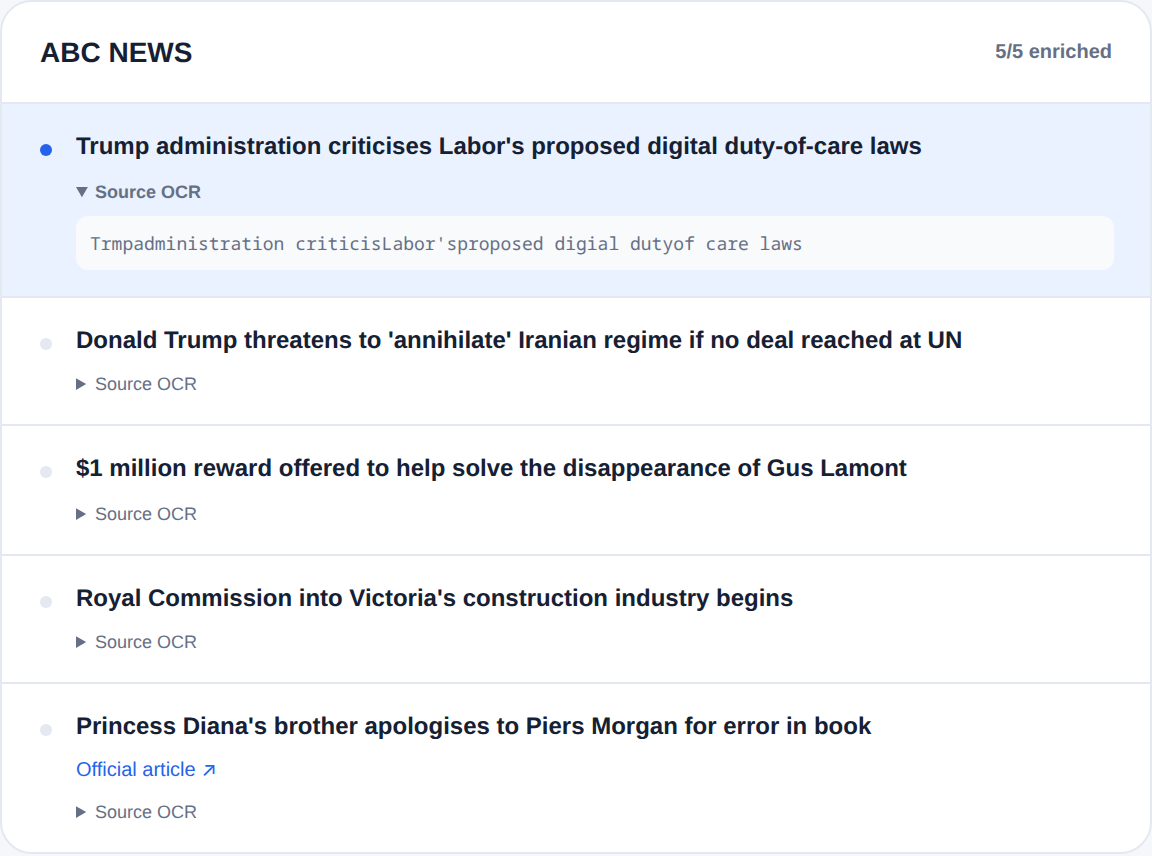
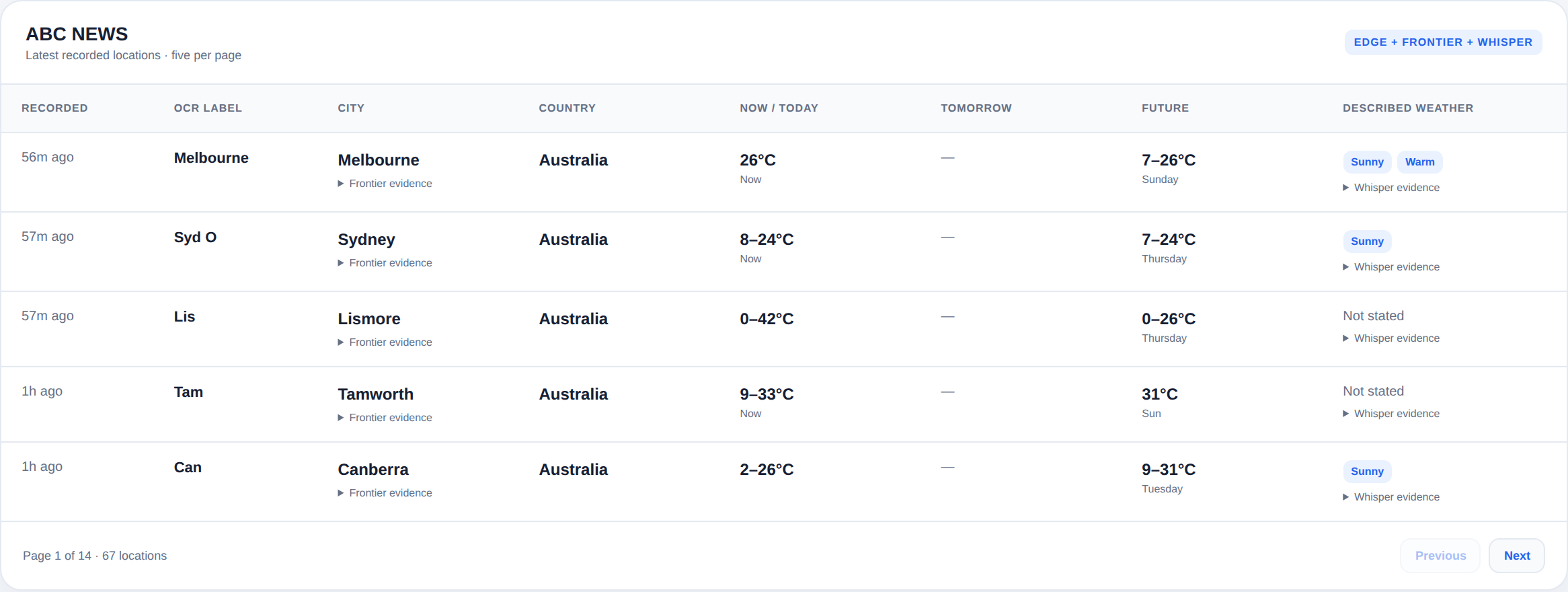
Actual dashboard screenshots captured 24 September 2026. Relative times shown inside the images refer to capture time. Click either image to enlarge.
Download these recorded outputs ↗ · Explore the live dashboard ↗
Analytics includes selected images.
0.97 hours with both feeds running (about 58 minutes).
Text, observations, status and portraits.
Projected from a concurrent 30-second sample; this is not a new 1 GB measurement. Running time is elapsed time for two feeds together, not per-feed hours. Application-data comparison, not a Starlink speed test. The video preview you are watching uses additional bandwidth.
Cameras at the site
NVIDIA Jetson Orin NX
Compact updates over Starlink
Searchable dashboard evidence
Scale the measured average to a different number of feeds. Set an illustrative uplink budget to see how much capacity each approach would use.
Illustration only. Workload, image frequency and link conditions change the outcome.| Per day | 30 days | |
|---|---|---|
| Video | ||
| Analytics | ||
| Reduction |
A 30-second recording of the current ABC NEWS and BBC News demo feeds. The boxes come from the live application. The presentation adds explanations; it does not simulate detection results.
Concurrent samples compared encoded video payload with outgoing MQTT message payload, including selected face images. Video sample durations were normalised to 30 seconds. Network headers, encryption and retransmissions were not measured.
In the remote-site design, local cameras feed the edge device and compact findings cross the satellite uplink. This lab uses internet news streams, so it does not eliminate their download traffic. Watching live video remotely still consumes video bandwidth.
This sample demonstrates reduced data for remote analytics. It does not establish surveillance accuracy, guaranteed savings, satellite performance or guaranteed monetary savings. Faces are local visual clusters, not verified identities.
SIGMA manages application deployment, configuration and software updates across remote sites. Package tested AI models with the vision application and deploy new versions remotely.
That creates a way to add detection tasks and other features over time, with fewer site visits for software changes. The lifecycle sequence in the reel is an illustration; it is not a recorded fleet rollout.
Read about SIGMA application management ↗